Treatment at the Dead Sea itself has good evidence for clearing psoriasis for a few months. A Dead Sea salt bath at home is a different thing. It can help soften and lift scale and ease itch before you moisturize, and the National Psoriasis Foundation lists it as one possible home remedy for that purpose. There is no evidence that a home salt bath treats psoriasis, and it does not replace the treatment a dermatologist can offer.
The difference comes down to two things a bag of salt cannot deliver: the strong, filtered sunlight at the lowest place on earth, and salt concentrations many times higher than anyone uses in a home bath. Below we go through the studies, what they mean for you, and how to use a salt bath safely.
The short answer
- At the Dead Sea: supervised sun exposure plus bathing, usually for about four weeks, clears or greatly improves psoriasis in most patients in published studies, but it comes back within months.
- Salt plus light in a clinic: salt-water baths followed by UVB light may work somewhat better than UVB alone. Trials disagree on how much the salt adds.
- Salt bath at home, no light: useful for softening scale and comfort. Not a treatment.
- What to do: see a dermatologist. Psoriasis is an immune-mediated disease, and effective treatments range from creams to light therapy to tablets and injections.
Why the Dead Sea is different from your bathtub
The Dead Sea shore lies more than 400 meters below sea level. The usual explanation is that sunlight there passes through an extra layer of atmosphere and haze, which filters more of the short-wave, burning part of the ultraviolet light. Patients can stay in the sun longer for the same risk of burning, on exposure schedules set by doctors from years of UV measurements at the site (Kudish et al., 2022). They also bathe in water so salty that it is closer to a brine than to sea water.
A home bath reproduces neither. In the largest clinic trial of Dead Sea salt baths, the solution was 10% salt. In a typical home bath of about 150 liters, one or two cups of Dead Sea salt gives a concentration of roughly 0.2 to 0.4%, at least 25 times weaker, with no light treatment afterwards.
What the research shows
- Systematic review: a review of the Dead Sea medical literature found “bona fide evidence” that Dead Sea treatments are especially effective for psoriasis, attributing the effect both to the special character of the sun’s ultraviolet radiation there and to bathing in the water. It found no evidence of more skin cancer, though sun damage to the skin appeared to increase in treated patients (Katz et al., 2012).
- How long it lasts: in a Danish study of 18 patients who spent four weeks at the Dead Sea with planned sun exposure and bathing, psoriasis severity (PASI) fell by an average of 88%. But symptoms came back after an average of about three months, and the authors saw no long-term disease control (Emmanuel et al., 2020). The study was small and had no comparison group.
- Salt bath plus UVB in a clinic: a Cochrane review of eight randomized trials found that a salt-water bath followed by artificial UVB light may improve psoriasis more than UVB alone, but rated the evidence as low certainty (Peinemann et al., 2021).
- The trials disagree: the largest, with 367 patients in Germany, found that bathing in a 10% Dead Sea salt solution during narrowband UVB gave a clinically relevant extra improvement over UVB alone (Klein et al., 2011). A Scottish trial of 60 patients, which soaked one limb in Dead Sea salt before UVB and compared it with the other limb, found no clinically important improvement from the salt (Dawe et al., 2005).
Put together, the light does most of the work. The salt may add something when it is used at high concentration right before or during light therapy. No study we found shows that a Dead Sea salt bath on its own, at home, improves psoriasis.
If you are interested in the real thing, our guide to Dead Sea psoriasis treatment in Israel covers the clinics, how a stay works and what it costs in time.
What a salt bath at home can do
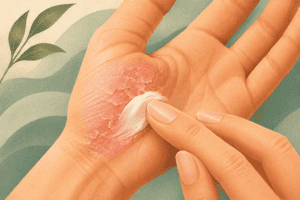
A warm soak softens psoriasis scale so it lifts more easily, and a softer, less scaly surface lets moisturizers and prescribed creams work better. The American Academy of Dermatology recommends a warm, not hot, 15-minute bath before applying a scale softener for exactly that reason (AAD).
The National Psoriasis Foundation describes adding Dead Sea or Epsom salts to warm, not hot, bath water and soaking for about 15 minutes as one possible way to remove scale and ease itching, and advises applying moisturizer after bathing to avoid dry skin (National Psoriasis Foundation). That is a comfort measure, and a reasonable one. Plain warm water also softens scale; whether the salt adds much at home strength has not been tested.
How to use a Dead Sea salt bath for psoriasis
- Check your skin. Skip the salt if plaques are cracked, bleeding or raw; it will sting.
- Use plain salt. Choose an unscented product whose only ingredient is Dead Sea salt. Our guide to the best Dead Sea salt products lists several.
- Dissolve 1 to 2 cups in a bath of warm, not hot, water. Hot water dries the skin and can trigger itch.
- Soak for about 15 minutes, no longer. The AAD recommends limiting baths to 15 minutes or less and taking only one bath or shower a day.
- Do not scrub. Let loose scale come away on its own with gentle hand washing. The AAD tells people with psoriasis that scrubs are too harsh and to skip loofahs, buff puffs and washcloths, which can irritate the skin and cause psoriasis to flare (AAD). Do not pick or peel plaques.
- Blot, then moisturize within five minutes. Pat the skin so it stays slightly damp, apply any prescribed treatment as directed, then a thick, fragrance-free cream or ointment to all of your skin.
- Watch how your skin responds over a few weeks. If it is drier or more irritated, go back to plain water.
Avoid Dead Sea salt scrubs on psoriasis, however natural the ingredients. Rubbing salt crystals over plaques is exactly the kind of friction the AAD advises against.
Itchy psoriasis
Many people with psoriasis say the itch is the worst part. The AAD’s advice is to treat the psoriasis itself, since that is the most reliable way to stop the itch, and in the meantime to moisturize instead of scratching, stick to warm water, and place a cool, damp washcloth on itchy skin, because itch nerves work less well when they are cold (AAD). A short salt bath followed by moisturizer fits into that routine; it is not a substitute for it.
Do not try to copy the Dead Sea sun at home
Patients at the Dead Sea are given a sun schedule that builds up gradually and is adjusted by doctors. Sunbathing at home to imitate it risks sunburn and long-term skin damage, and the Katz review found increased sun damage even in supervised patients. If light helps your psoriasis, ask a dermatologist about phototherapy, which delivers measured doses in a clinic.
When to see a dermatologist
See a dermatologist if you think you have psoriasis, if it is spreading or affecting your nails, scalp, face or genitals, if it is affecting your sleep or mood, or if over-the-counter care is not enough. Joint pain, stiffness or swelling can be a sign of psoriatic arthritis and needs medical assessment. Get prompt medical care for redness that spreads over most of the body, or for widespread pus-filled bumps with fever or chills, which can signal rarer, more serious types of psoriasis.
For gentle products that suit psoriasis-prone skin, see our list of gentle skin care products for psoriasis and eczema. If you are not sure which condition you have, our guide to psoriasis or eczema explains the differences.
Frequently asked questions
Does Dead Sea salt cure psoriasis?
No. Psoriasis is a long-term condition. Even the excellent results of treatment at the Dead Sea itself fade within months. A home salt bath can make scale easier to manage and the skin more comfortable.
How much Dead Sea salt should I put in a bath for psoriasis?
One to two cups in a standard bath is the amount most often suggested. The clinical studies used far stronger solutions combined with light therapy, so adding more salt at home will not reproduce their results and is more likely to dry or sting the skin.
Is Epsom salt as good as Dead Sea salt for psoriasis?
For softening scale at home, there is no evidence that one beats the other; the National Psoriasis Foundation mentions both. The clinical research used Dead Sea salt or other salt-water solutions together with UV light.
Can I use Dead Sea salt on scalp psoriasis?
Salt dries hair and can sting a scratched scalp. Scalp psoriasis usually needs a medicated shampoo or scalp treatment; ask your dermatologist which one suits you.
How often can I take a Dead Sea salt bath?
The AAD suggests one bath or shower a day at most, kept to 15 minutes or less. A salt bath two or three times a week, always followed by moisturizer, is a reasonable routine if your skin tolerates it.