Some do, for some things, and much less than the marketing says. The best evidence is for Dead Sea salt baths on dry, rough skin and for treatment at the Dead Sea itself for psoriasis, where sunlight does a large part of the work. Dead Sea mud is gentle and well tolerated but has only modest measured effects on healthy skin. For most face creams and body lotions, the Dead Sea ingredient is a minor component, and the cream works the way any well-made moisturizer works: through its glycerin, oils and emollients.
This guide goes through what is actually in Dead Sea products, what the published studies found and where they stop, and how to read a label so you know what you are paying for.
The short answer
- Salt baths: reasonable evidence for softer, better-hydrated dry skin, from one small but well-designed study. Claims that you absorb magnesium through the skin are not supported.
- Mud masks: well tolerated, oil-absorbing, pleasant. Measured effects on healthy skin are small.
- Creams and serums: almost no product-level research. Judge them as moisturizers first, and check where the Dead Sea ingredient sits on the label.
- Psoriasis and eczema: the strong results come from supervised treatment at the Dead Sea, combining bathing with the region’s sunlight. Products at home are a comfort measure, not a treatment. See a dermatologist.
How we evaluated the evidence
We searched PubMed for human and laboratory studies on Dead Sea salt, water, mud and mineral cosmetics, read the abstracts and, where available, the full papers, and noted the study design, size and who funded or ran it. Several of the best-known papers were written by scientists working for Dead Sea cosmetics companies; we say so where it applies. We did not run our own tests. The product label analysis uses ingredient lists published by the brands.
What is actually in a Dead Sea product
“Dead Sea” on a pack can mean one of three raw materials. Each has its own name on the ingredient list, and that is the quickest way to see what you are buying.
| Raw material | Name on the label | Typical products |
|---|---|---|
| Dead Sea salt | Maris Sal, Dead Sea salt | Bath salts, salt scrubs, some cleansers |
| Dead Sea water (concentrated brine) | Maris Aqua, Dead Sea water; AHAVA calls its version Osmoter | Creams, serums, lotions |
| Dead Sea mud | Silt, Maris Limus, Dead Sea mud | Face and body masks, mud soaps |
The lake’s water is far saltier than the ocean, and its salts are dominated by magnesium and calcium chlorides rather than the sodium chloride that makes up most sea salt. That unusual mineral mix is the whole basis of the category. Researchers describe the lake as roughly ten times saltier than the oceans, with total dissolved salts reaching about 347 grams per liter. As the lake has evaporated, much of its sodium has settled out as rock salt, leaving magnesium as the dominant mineral in the water (Bodaker et al., 2010; Ionescu et al., 2012).
The mud is a fine clay-rich sediment from the shore, made mainly of clay and carbonate minerals and soaked in the same brine. In skin care terms it behaves like a clay: it absorbs oil and leaves skin feeling clean and tight.
What the research shows, product by product
Dead Sea salt baths: the best evidence for dry skin
The most cited study gave volunteers with dry, atopic skin a forearm soak for 15 minutes a day in a 5% solution of a magnesium-rich Dead Sea salt, with the other forearm in tap water, for six weeks. The salt-treated arm was better hydrated, less rough and less red. Barrier function improved significantly only in people whose barrier was already impaired at the start (Proksch et al., 2005).
That is a real result, but it is one salt, one small group and a solution much stronger than most people use at home. The popular claim that a bath “tops up” your magnesium does not hold: a review of transdermal magnesium, including salt baths and magnesium flakes, concluded that it is scientifically unsupported (Gröber et al., 2017). For product picks, see our guide to the best Dead Sea salt products for bath and skin.
Dead Sea mud: gentle, with modest measured effects
In a four-week study, healthy volunteers applied three kinds of Dead Sea mud to their forearms every other day. The mud was well tolerated and did not damage the skin barrier, but hydration did not change significantly, and only one salted mud showed a slight firming effect (Hamed et al., 2021).
The antibacterial claims you see on mud masks come from a laboratory study in which acne-related bacteria lost viability when mixed into Dead Sea mud (Ma’or et al., 2006). That is a test-tube result. It does not show that a mask clears acne on real skin. Our Dead Sea mud mask comparison covers which masks actually put the mud near the top of the label.
Creams, serums and lotions: the weakest evidence
This is the category most people buy, and it has the least research behind it. The studies that exist are small, and most were run by scientists working for a Dead Sea cosmetics company:
- In a four-week study of 20 women, skin roughness fell by 40.7% with a gel containing 1% Dead Sea minerals, by 27.8% with the same gel without minerals, and by 10.4% with a control gel (Ma’or et al., 1997). The first author worked for AHAVA’s maker. Notice that most of the improvement came from the gel base itself.
- Two AHAVA creams reduced wrinkle depth and raised skin moisture in laboratory tests and a volunteer study by AHAVA-linked authors; the abstract does not give the number of volunteers (Wineman et al., 2012).
- In mice, applying magnesium salts, and mixtures of magnesium and calcium, sped up recovery of a damaged skin barrier (Denda et al., 1999). This is a plausible mechanism, not proof that a cream works on people.
What we can say with confidence is how these products are built. In the labels we have checked, the Dead Sea ingredient is often one of the last items listed. In AHAVA’s Mineral Hand Cream and Mineral Body Lotion, for example, Dead Sea water is the very last ingredient, while in its Crystal Osmoter X6 serum it is fourth. Both kinds of product can feel good, but in the first case the moisturizing comes from glycerin and emollients, not from the minerals.
That is not a reason to avoid them. A well-made moisturizer helps dry skin whatever the source of its minerals. The American Academy of Dermatology’s advice for dry skin is to use a cream or ointment rather than a lotion, apply it right after washing, look for ingredients such as glycerin, shea butter, petrolatum or dimethicone, and choose fragrance-free products (AAD). Dead Sea minerals are not on that list. It is a reason not to pay a premium for “Dead Sea” alone. We compare face creams on this basis in our list of the best Dead Sea moisturizers.
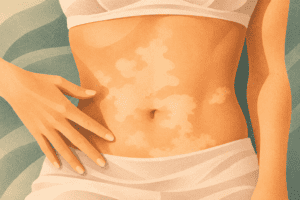
Psoriasis and eczema: the evidence is for the place, not the product
The famous psoriasis results come from treatment stays at the Dead Sea. A systematic review found good evidence for psoriasis there and attributed the benefit to both the solar ultraviolet radiation at the site and to bathing in the lake (Katz et al., 2012). A Cochrane review of salt baths followed by artificial UVB found low-certainty evidence that the combination may work better than UVB alone (Peinemann et al., 2021).
None of this shows that a cream or a bag of salt at home treats psoriasis or eczema. If you have either condition, see a dermatologist, and ask whether salt soaks or a mineral moisturizer can sit alongside your treatment. For eczema, the NHS lists emollients, applied at least twice a day, and steroid creams as the main treatments (NHS). A fragrance-free Dead Sea cream can be an emollient; it does not replace prescribed treatment.
Studies of eczema at the Dead Sea point the same way. Adults with atopic dermatitis improved after a climatotherapy stay, but there was no comparison group (Adler-Cohen et al., 2012), and a non-randomized study in children found a similar improvement after four weeks at the Dead Sea as after a month of steroid creams, with many children lost to follow-up (Marsakova et al., 2020). Both studied the climate and sun of the region, not products used at home.
Why Dead Sea products often feel like they work
Many people say Dead Sea products leave their skin calmer and softer, and that is usually true. It just has several causes that have nothing to do with minerals:
- The base formula. Glycerin, plant oils, shea butter and silicones make almost any skin feel smoother within minutes.
- Salt and mud texture. A salt scrub removes dead surface cells mechanically, and a mud mask absorbs oil. Both give an instant “fresh” feel.
- Fragrance and ritual. A scented bath or mask is pleasant, and pleasant routines get repeated, which matters more for dry skin than any single ingredient.
The honest summary is that a good Dead Sea product works about as well as a good product without Dead Sea ingredients, with a small, plausible extra for salt soaks on dry skin.
How to tell whether a product is the real thing
People often ask how to find authentic Dead Sea products. “Made in Israel” or “from the Dead Sea” on the front tells you little. The ingredient list tells you more.
- Find the Dead Sea ingredient by name. Look for Maris Sal, Maris Aqua, Silt or Maris Limus. If none appears, the product is Dead Sea in name only.
- Check its position. Ingredients are listed in descending order of weight, but anything at 1% or less can be listed in any order after the rest (FDA Cosmetics Labeling Guide). An ingredient in the last few places is a minor component.
- Look at what sits above it. If fragrance (Parfum) comes before the Dead Sea ingredient, the product contains more perfume than Dead Sea material.
- Do not assume Israel versus Jordan decides quality. The lake borders both, and salt and mud are produced on both shores. What you can check is whether the brand names its source and publishes a full ingredient list.
Our guide to Dead Sea skin care brands covers who makes the main brands and where.
Safety: what to watch for
- Metals in mud. A 2026 study measured nine metals in 95 samples of raw Dead Sea mud and mud-based cosmetics bought in Jordan and found low to moderate levels, generally in line with European and North American guidance, while calling for routine quality control (Massadeh et al., 2026). A 2015 assessment co-written by AHAVA scientists advised people already allergic to nickel or chrome not to use Dead Sea mud on the skin (Ma’or et al., 2015).
- Fragrance. Many Dead Sea creams and scrubs are strongly scented. Fragrance is one of the main classes of cosmetic allergens the FDA lists (FDA). If you react to perfume, check the label first.
- Salt on broken skin. Salt scrubs and strong salt soaks sting on cuts, fresh shaving and active eczema patches.
- Never drink it. Swallowing Dead Sea water is dangerous because of its very high mineral load (Katz et al., 2012). Keep bath salts away from children.
Who is most likely to notice a difference
- Dry, rough skin on the body: regular salt soaks followed by a moisturizer are the best-supported use.
- Oily or congested skin: an occasional mud mask absorbs oil and feels clarifying. Expect a cosmetic effect, not acne treatment.
- Dry or mature facial skin: a rich Dead Sea face cream will help as a moisturizer. Choose it for the formula, not the minerals. See our best Dead Sea face products.
- Sensitive or fragrance-allergic skin: the category is risky because so many products are scented. Look for unscented salt and plain mud, and patch test.
Frequently asked questions
Are Dead Sea cosmetics worth the money?
Plain Dead Sea salt and plain mud are inexpensive and do what they claim. For creams and serums, you are mostly paying for the base formula and the brand. Compare them with other moisturizers on texture, fragrance and price, and treat the Dead Sea ingredient as a minor extra unless it is high on the list.
Do Dead Sea products help psoriasis?
The evidence is for supervised treatment at the Dead Sea, where bathing is combined with the local sunlight. Home products may soothe dry, scaly skin, but they are not a treatment. Talk to a dermatologist before adding salt soaks to a psoriasis routine.
Can Dead Sea products dry out skin?
Yes. Strong salt soaks, salt scrubs and mud masks left on until they crack can all leave skin tight. Rinse, pat dry and apply a moisturizer straight away.
How do I know if a Dead Sea product is authentic?
Check that the ingredient list names Maris Sal, Maris Aqua, Silt or Maris Limus, and see how high it sits. A brand that publishes its full ingredient list and says where its raw material comes from is easier to trust than one that relies on the words “Dead Sea” on the front.