Dead Sea climatotherapy, a supervised stay of several weeks with measured sun exposure and sea bathing, has been studied for vitiligo, and some patients regain color during treatment. But the evidence is much thinner than for psoriasis. The largest study was a retrospective review with no comparison group, and in it only about 4 percent of patients reached significant repigmentation. Dead Sea salt, mud or creams used at home have no evidence for vitiligo at all.
Vitiligo has no cure, and treatment works slowly. If you are considering the Dead Sea, treat it as a form of phototherapy, and plan it with a dermatologist. Here is what vitiligo is, what the Dead Sea studies found, and how vitiligo is treated today.
What vitiligo is
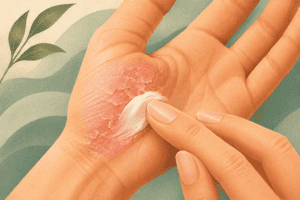
Vitiligo is a long-term autoimmune condition in which the immune system attacks melanocytes, the cells that make skin pigment, leaving pale or white patches (NIAMS). It affects roughly 0.5 to 2 percent of people worldwide, across all skin colors, though it is more visible on darker skin (Skin Health and Disease, 2024).
- It is not contagious. “You cannot catch vitiligo from someone or give it to anyone” (AAD).
- It is not caused by burns, although a bad sunburn or skin injury can trigger new patches in someone who has vitiligo (NIAMS).
- There are two main types. Non-segmental vitiligo, the most common, usually appears on both sides of the body and is thought to be autoimmune. Segmental vitiligo affects one area on one side and tends to stop spreading after a while (NHS).
- Common sites include the face, hands, around body openings, and areas of friction. Hair growing in a patch can turn white.
Vitiligo is usually not harmful to physical health, but it can affect self-esteem and quality of life, and that is a valid reason to seek treatment.
What the Dead Sea studies found
Dead Sea climatotherapy uses the same idea as for psoriasis: the shore lies more than 400 meters below sea level, and the extra layer of atmosphere is thought to filter more of the burning part of UVB, so patients can spend longer in the sun. For vitiligo, the goal is to use that ultraviolet light to stimulate melanocytes to repigment the patches. We explain the sunlight science in our article on Dead Sea psoriasis treatment.
The 436-patient study
The largest study reviewed the files of 436 vitiligo patients treated at a Dead Sea clinic between 1997 and 2005. Treatment was graded sun exposure after bathing in the sea (Czarnowicki et al., 2011). The reported short-term results were:
- 3.9 percent had total or significant repigmentation (more than half of the color back in more than half of the patches).
- 81.4 percent had what the authors called “good repigmentation.”
- 13.1 percent had no repigmentation, though the patches turned pink.
- 1.6 percent were unaffected.
Patients did better when their patches were smaller, their vitiligo was more recent, and they stayed longer.
Read these numbers with care. This was a retrospective review of clinic records, with no comparison group, from the treating clinic itself. It measured only the short-term response, so we do not know how much color lasted after patients went home. The headline “81 percent good repigmentation” is a soft category; the stricter measure, significant repigmentation, was reached by fewer than 1 in 20 patients.
Smaller studies
- In a study of 59 patients over 21 days, repigmentation started at days 10 to 16 when climatotherapy was combined with a pseudocatalase cream, compared with 5 to 6 weeks with climatotherapy alone (Schallreuter et al., 2002). This was a small study, and pseudocatalase is not a standard treatment.
- A study of 71 patients after 20 days at the Dead Sea found that quality of life improved and stayed better at 12 months in the 33 patients who were followed up (Krüger et al., 2011). It measured quality of life, not color.
What this adds up to
The Dead Sea works, to the extent it does, as natural phototherapy. Phototherapy is a standard vitiligo treatment, so it is plausible that carefully dosed sun at the Dead Sea helps some people, especially those with recent, limited patches. What is missing is a controlled trial comparing it with clinic phototherapy at home, which is easier to access, more precisely dosed and can run for the many months vitiligo usually needs. Claims that Dead Sea minerals “restore” the immune or endocrine system, or that the air itself treats vitiligo, are not supported by evidence.
What about Dead Sea salt, mud and creams at home?
There are no studies showing that Dead Sea bath salts, mud masks or mineral creams repigment vitiligo patches. In the climatotherapy studies, the active ingredient is the sun, and that stays at the Dead Sea. A salt bath at home can leave skin dry, so moisturize afterwards, and avoid scrubbing depigmented skin, since friction and injury can trigger new patches in vitiligo.
How vitiligo is treated today
Treatment aims to stop new patches and bring back some color. Results vary, are slow, and often need months. Options include (AAD; NHS):
- Topical steroids for a limited time, usually for smaller areas.
- Calcineurin inhibitor creams (tacrolimus, pimecrolimus), often used on the face. In the UK these are used off-label for vitiligo.
- Ruxolitinib cream, a JAK inhibitor approved by the FDA in July 2022 for non-segmental vitiligo in people aged 12 and over. In the two trials, 30 percent of patients reached at least 75 percent improvement in facial vitiligo at 24 weeks, compared with 10 percent on a placebo cream (FDA).
- Phototherapy with ultraviolet light in a clinic, and targeted lasers for small areas.
- Surgery, such as skin grafts or cell transplants, for stable vitiligo that has not changed for some time.
- Skin camouflage makeup and self-tanners, which many people use alone or alongside treatment.
Even after successful treatment, color can fade again: the AAD notes that about 40 percent of people lose some regained color within a year of stopping treatment.
Protecting skin with vitiligo from the sun
Skin without pigment has no natural protection and burns easily, and a bad sunburn can make vitiligo worse (AAD). The NHS advises sunscreen with SPF 50 or above on affected skin (NHS), and the AAD recommends broad-spectrum, water-resistant sunscreen reapplied every two hours outdoors. This is also why a Dead Sea stay must follow a dosed exposure plan: unsupervised long sunbathing risks burns on exactly the skin you are trying to help.
If you are considering a Dead Sea stay
- Get a confirmed diagnosis and type. Other conditions cause pale patches, including fungal infections and post-inflammatory hypopigmentation.
- Ask your dermatologist whether phototherapy suits you, and whether clinic phototherapy or ruxolitinib cream at home would be a more practical first step.
- Plan several weeks under medical supervision, with a sun schedule built up gradually and protection for unaffected skin and your eyes.
- Agree a maintenance plan for when you return, since vitiligo usually needs ongoing treatment.
For other skin conditions and the Dead Sea, see Dead Sea salt for psoriasis and how to tell psoriasis from eczema.
FAQ
Can the Dead Sea cure vitiligo?
No. Supervised sun exposure at the Dead Sea may bring back some color in some patients, but vitiligo has no cure, and the evidence comes from uncontrolled studies.
Does Dead Sea salt help vitiligo?
There is no evidence that Dead Sea salt or mud used at home repigments vitiligo.
Is sun good or bad for vitiligo?
Controlled, measured ultraviolet light is a treatment. Sunburn is harmful and can trigger new patches. Protect depigmented skin and get light therapy only under medical guidance.
Is vitiligo hereditary?
It can run in families, and many people with vitiligo have relatives with it or with other autoimmune conditions, but most children of a parent with vitiligo do not develop it.