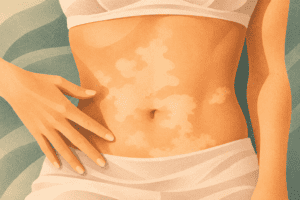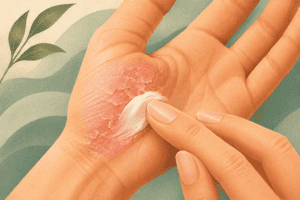
The short answer: your skin sheds dead cells constantly, and you only notice them when shedding slows down or the surface dries out, leaving flakes, rough patches or a dull look. The fix is usually to moisturize better first, then exfoliate gently: a mild acid (lactic, glycolic or salicylic) or a soft washcloth, one to three times a week depending on your skin. Harsh scrubs and frequent peels make it worse. Flaking that keeps coming back in the same places, especially around the nose, eyebrows or hairline, or rough spots that do not heal, should be checked by a dermatologist.
Why dead skin builds up
The outer layer of skin, the stratum corneum, is made of flattened dead cells held together by natural “glue” proteins and lipids. Enzymes in a well-hydrated skin surface slowly dissolve that glue, and cells drop off one by one without you seeing them. When the surface is dry, those enzymes work poorly, and cells come away in visible clumps instead. Common reasons:
- Dry air and weather. Cold, dry winters and heated or air-conditioned rooms. Low humidity weakens the skin barrier (Engebretsen et al., 2016).
- Over-cleansing. Hot water, foaming cleansers and washing too often strip the lipids skin needs to shed normally.
- Age. Older skin makes less oil and renews more slowly, so it looks duller and rougher.
- Sun damage. Years of UV exposure thicken and roughen the surface.
- Active ingredients. Retinoids, benzoyl peroxide and acids cause peeling, especially in the first weeks.
- Skin conditions. Seborrheic dermatitis, eczema and psoriasis all cause flaking (see below).
Step one: moisturize before you exfoliate
If your face flakes, the first question is whether it is simply dry. Exfoliating dry skin removes the flakes for a few hours, but the irritated surface flakes again. Try two weeks of gentle cleansing with lukewarm water, a moisturizer applied to damp skin twice a day, and a humidifier in dry rooms. Moisturizers with lactic acid or urea also loosen flakes gently while they hydrate; the American Academy of Dermatology (AAD) lists lactic acid among the ingredients to look for in dry skin (AAD, Dry skin). Our guide on how to moisturize your skin without moisturizer covers simple options.
Often that alone fixes it. If your skin is still rough or dull, add exfoliation.
Step two: choose an exfoliation method for your skin
There are two kinds. Mechanical exfoliation uses a tool or a scrub to lift dead cells. Chemical exfoliation uses acids or enzymes to loosen the bonds between them. The AAD’s guidance (AAD, How to safely exfoliate at home):
- Dry, sensitive or acne-prone skin: a washcloth and a mild chemical exfoliant; mechanical methods may be too irritating.
- Oily or thicker skin: stronger chemical treatments or mechanical exfoliation may be fine.
- Darker skin tones, or skin that darkens after acne or injury: avoid strong exfoliation, which can cause more dark spots.
- The more aggressive the method, the less often to use it.
| Exfoliant | Best for | Notes |
|---|---|---|
| Lactic acid (AHA) | Dry, dull, sensitive skin | Gentler than glycolic, also hydrates |
| Glycolic acid (AHA) | Normal to oily skin, rough texture, sun damage | Small molecule, works fast, more likely to sting |
| Salicylic acid (BHA) | Oily skin, blackheads, breakouts | Oil-soluble, works inside pores |
| PHAs (gluconolactone, lactobionic acid) | Very sensitive skin | Larger molecules, mild effect |
| Fruit enzymes (papain, bromelain) | Sensitive skin wanting a light polish | Mild, results vary with formula |
| Soft washcloth | Most skin types | Simple and easy to control; use light pressure |
| Grainy scrubs | Oily, resilient skin only | Choose fine, round particles; avoid crushed shells and salt on the face |
Salt and sugar scrubs are made for the body, where skin is thicker. On the face their sharp crystals can cause tiny tears. If you enjoy a salt scrub, use it from the neck down; see our comparison of Dead Sea salt body scrubs.
Using acids safely
In the US, the industry’s Cosmetic Ingredient Review panel considers glycolic and lactic acid products safe for consumers at 10 percent or less, with a pH of 3.5 or higher, and with directions to use daily sun protection. The FDA found that AHAs increase the skin’s sensitivity to sunburn, an effect that fades about a week after stopping, and recommends a “Sunburn Alert” on labels (FDA, Alpha Hydroxy Acids). So:
- Use acids at night and wear sunscreen every day.
- Do not stack several acids, or an acid with a retinoid on the same night, until you know your skin tolerates both. The AAD warns that combining exfoliation with retinoids or benzoyl peroxide can worsen dryness and breakouts.
- Leave higher-strength peels to professionals.
- Never exfoliate sunburned, broken or inflamed skin.
How often to exfoliate
| Skin type | Typical frequency |
|---|---|
| Sensitive | Once a week, with a PHA, lactic acid or washcloth |
| Dry | Once or twice a week |
| Normal or combination | Two or three times a week |
| Oily | Up to every other day with a low-strength BHA, if tolerated |
These are starting points, not targets. If your skin turns red, tight, shiny-smooth or starts stinging with your usual moisturizer, you are over-exfoliating. Stop for a week or two and let it recover.
How to exfoliate, step by step
- Cleanse gently with lukewarm water.
- For a scrub or washcloth: use small circular motions with light pressure for about 30 seconds, then rinse, as the AAD suggests. For an acid toner or serum: apply to dry skin and leave on as directed.
- Moisturize right away, since exfoliation is drying.
- Apply sunscreen the next morning, every morning.
Masks and DIY options
Peel-off masks remove some surface debris and fine hairs as they lift off, and clay or mud masks absorb oil. They give a quick smoothness but are not a substitute for regular gentle exfoliation. If you want to make one at home, our recipes for DIY peel-off face masks explain what each really does. Avoid lemon juice, baking soda and undiluted vinegar, which upset the skin’s acidity and can burn.
When flaking is not just dead skin
- Greasy yellow or white flakes around the nose, eyebrows, between the brows, the beard or hairline, often with redness, suggest seborrheic dermatitis (DermNet). It responds to medicated washes, not scrubbing.
- Itchy, red, dry patches that come and go may be eczema. See psoriasis or eczema?
- A rough, scaly spot that does not go away on sun-exposed skin, such as the nose, forehead or the back of the hands, can be an actinic keratosis, a precancerous lesion (DermNet). Do not keep exfoliating it; have it checked.
- Peeling after starting a retinoid is expected. Reduce how often you use it rather than scrubbing the flakes off.
A simple routine for smoother skin
- Morning: lukewarm rinse or gentle cleanser, moisturizer, sunscreen.
- Evening: gentle cleanser, a mild acid on one to three nights a week (not on retinoid nights), moisturizer.
- Weekly: an optional mask, and nothing harsher.
Frequently asked questions
Why does my face have dead skin even though I exfoliate?
Usually because the skin is dry or irritated, and exfoliating more makes it flake more. Cut back, moisturize on damp skin, and use a humidifier. If it persists, consider seborrheic dermatitis or eczema.
Can I remove dead skin with a homemade face mask?
A gentle mask with oats or yogurt can soften skin, and a peel-off mask lifts some debris. Avoid acidic or gritty kitchen ingredients like lemon, sugar and salt on the face.
Is it bad to peel dead skin off my face?
Yes. Pulling flakes off tears the living skin underneath, which leads to redness and, in darker skin, dark marks. Moisturize and let them shed.
Does dead skin cause acne?
Dead cells that stick inside pores are part of how blackheads and pimples form, which is why salicylic acid helps acne-prone skin. See why acne breaks out.